top of page
Search


Walter Leather Bespoke · Guadalajara Atelier · Est. 1990


For over thirty-five years, we have been cutting leather by hand. Every jacket. Every backpack. Every bag. Every piece that has left this atelier began the same way — with a hide on a table, a pattern, and a blade that does not allow for repetition. Every cut is the cut.

What we have done with that knowledge across three decades of commissions — the color combinations, the texture decisions, the understanding of how different leathers behave alongside each other — has always lived inside the pieces we make to be worn and carried.

Until now, we have kept it there.


We are bringing that same hand, that same eye, and those same materials to something new. Leather artwork for your walls. Conceived, cut, and assembled entirely in Guadalajara. Scaled to your space. Personal to you. No two pieces alike — not in design, not in material, not in the life that went into making them.


This is not a side project. It is a natural extension of everything we have always done.


THE MATERIAL — KID SKIN


The leather we work with for our artwork pieces is kid skin — the hide of the baby goat, one of the most refined and particular leathers available anywhere in the world.


Kid skin is the material of choice in high fashion footwear. The great design houses use it for shoes precisely because of what it does under the hand — its fineness of grain, its extraordinary range of color, the way it accepts dye and finish at a depth that coarser hides cannot achieve. It is a leather that rewards close attention. The more carefully you look at it, the more it gives back.


For leather artwork, kid skin is unmatched. Its surface holds color with an intensity that makes combination work possible — layering shades, contrasting textures, placing warm tones against cool ones — in ways that thicker, less refined hides simply cannot achieve. It is supple enough to cut with precision and structured enough to hold its form on a wall without framing or sealing.


We source our kid skin with the same rigor we bring to every other material in the atelier. Multiple tanneries. Multiple countries. Each hide evaluated by hand before it enters a piece.


THE VISION — WHERE EVERY ARTWORK BEGINS


No two pieces begin from the same place. A leather artwork commission from this atelier begins with a conversation — the same conversation that begins every jacket, every bag, every bespoke piece we have ever made.


What is the space? What does it currently hold? What feeling should the piece create when someone enters the room — or when they stand close enough to see the stitching?

From that conversation, we build a vision. Not a mood board. Not a reference image. A genuine design direction built around four variables that interact with each other in ways that cannot be fully planned — only guided by thirty-five years of understanding how leather behaves.


Texture — kid skin is available in a range of natural and treated surfaces. Smooth, pebbled, buffed, embossed. Each catches light differently. Each sits differently alongside its neighbor. The texture combination in a piece determines its character at distance — what it looks like from across the room.


Shade and hue — we work with a spectrum that spans the full range of what vegetable and chrome tanning can produce. Deep forest greens. Warm ambers. Burnt siennas. Midnight blacks with blue undertones. Creams that are almost bone. The color decisions in a leather artwork are not decorative choices — they are structural ones. The wrong color in the wrong position changes everything.


Thickness — different sections of a piece use different weights of kid skin. Thicker cuts hold edges cleanly and create shadow and dimension. Thinner cuts layer over each other and allow the color beneath to influence what sits above. Thickness is the variable most people never see — and the one that determines whether a piece has depth or merely pattern.


THE CUT — BY HAND, WITHOUT REPETITION


Every section of a Walter Leather artwork is cut by hand. Not die-cut. Not laser-cut. By hand, with a blade, against a pattern drawn specifically for this piece.


This is not a romantic detail. It is a structural one. Hand cutting allows for decisions to be made in real time — adjustments to follow the grain of a hide, to avoid a natural mark, to honor the material's own character in ways that a mechanical process cannot. The blade follows the leather as much as the pattern.


Francis, who has cut leather in this atelier for over twenty years, brings to the artwork pieces the same precision he brings to every jacket panel and bag section. Each cut is deliberate. Each edge is clean. There is no recovery from a wrong cut — the material is too fine, and the design too specific, to allow it.


This is why no two pieces are alike. Not because we intend variation — but because the hand, the hide, and the moment are never exactly the same twice.


THE THREAD — SERAFIL AND GÜTERMANN


Thread in a leather artwork is not a fastening. It is a design element — one that contributes as much to the finished piece as the leather itself.


We work with two thread systems, each chosen for specific qualities and specific purposes within the artwork.


Serafil — a high-tenacity polyester thread produced to exceptional consistency of color and weight. Serafil is our choice for structural stitching — the lines that hold sections together, that define borders, that create the architecture of the piece. It holds its color over decades without fading. It does not stretch. It does not deteriorate in light. It is built to last as long as the leather it passes through.


Gütermann — one of the most respected thread manufacturers in the world, producing threads since 1864 in Gutach, Germany. Gütermann threads bring a fineness and range of color that makes them ideal for detail work — the stitching that creates texture on the surface of the piece, that traces a shape or defines a transition between materials. The color library is extraordinary. When we need a thread that matches a specific hue in a specific kid skin at a specific light condition, Gütermann is where we find it.


We use both threads in different thicknesses — heavier weights for structural lines that should read clearly at distance, finer weights for detail that reveals itself only to someone standing close. A leather artwork from this atelier rewards both experiences. What it looks like from across the room and what it gives back when you are close enough to see how it was made.


THE ASSEMBLY — PATIENCE MADE VISIBLE


The assembly of a leather artwork piece is where the vision, the cut, and the thread come together — and where thirty-five years of understanding how leather behaves becomes impossible to fake.


Each section is positioned by hand against the composition before any stitching begins. This is the stage where decisions are made and unmade — where a color that looked right in isolation reveals something unexpected alongside its neighbor, where a texture combination that worked in theory needs to be reconsidered in the actual material.


We do not rush this stage. It is where the piece either becomes what it was always meant to be or reveals that something needs to change. The atelier's experience lives here — in the ability to see, in real material, what a design decision actually produces.


Once the composition is resolved, the stitching begins. Section by section. Thread by thread. The final piece is not sealed, not varnished, not treated with any coating that would alter how the leather breathes, ages, or feels to the touch. Kid skin without sealing continues to live as leather does — developing subtly over time, responding to the light it receives, the air around it, the years it spends in the space.


This is intentional. A Walter Leather artwork is not a photograph of a material. It is the material. It continues to be what it is made of.


SCALE — TO YOUR SPACE


Leather artwork from this atelier is created as framed leather art for interior spaces, always respecting the natural size and character of the hide.


A single framed piece for a study. A pair of artworks for a hallway. A triptych for a dining room, office, or private garage. Each commission is designed around the material first: the size of the leather, the artwork being created, the hand-cut details, and the way the frame will live inside the room.


Almost any idea can be translated into leather artwork. A marque emblem. A personal symbol. A race-inspired composition. A design detail from a car, a jacket, or a piece of luggage. The only real question is how the material should be handled so the final piece feels intentional, balanced, and worthy of the space.


The commission always begins with the room. Its dimensions, its light, what currently occupies the wall, and what feeling the client wants the artwork to create. From there, we design the leather piece, the frame, the colors, and the construction around the space.

There is no catalog format. Each framed artwork is made around the idea, the material, and the space it is


THIS IS NEW. THE CRAFT IS NOT.


We want to be clear about what this service is and what it is not.

It is not a new direction for the atelier. It is an extension of the same work we have always done — cutting leather by hand, making decisions about color and texture and thread, building something that belongs entirely to one person.


What is new is the surface. For thirty-five years, the surface has been a jacket, a bag, a backpack. Now it is also a wall.


The conversation that begins a leather artwork commission is the same conversation that begins every piece we make. What do you need? What does your space hold? What should this become? We design around that, one commission at a time, until what emerges is something that could not have existed without you describing it.


BEGIN THE CONVERSATION


Leather artwork commissions are now open.

There is no catalog. No standard size. No fixed color palette. Every piece begins with a conversation and ends with something that has never existed before.

If you have something in mind — a space, a feeling, a color — write to us. We will take it from there.


Walter Leather Bespoke · Guadalajara Atelier · Est. 1990 The Quail · Pebble Beach · Amelia Island · Private Events Worldwide


TAGS: Leather wall art, hand cut leather artwork, kid skin leather, bespoke leather art, leather artwork commission, Guadalajara atelier, Serafil thread, Gütermann thread, leather interior design, wearable art, Walter Leather Bespoke, luxury wall art, custom leather artwork, baby goat leather, leather for walls, leather home decor, bespoke wall art

Walter Leather Bespoke · Guadalajara Atelier · Est. 1990


It Begins With Raw Materials, A Conversation and a Sketch


There is a moment at the beginning of every commission when nothing has been decided yet. The client has shared something — a car, a lifestyle, a feeling they are looking for — and we are standing in the atelier with the materials in front of us, deciding what this piece is going to be made of.


That decision is not made lightly. It is not made from a catalog. It is made from thirty-five years of understanding how materials behave, how they age, how they carry the life of the person who owns them. The design follows the material. The material follows the conversation.


This is what we work with. And why.

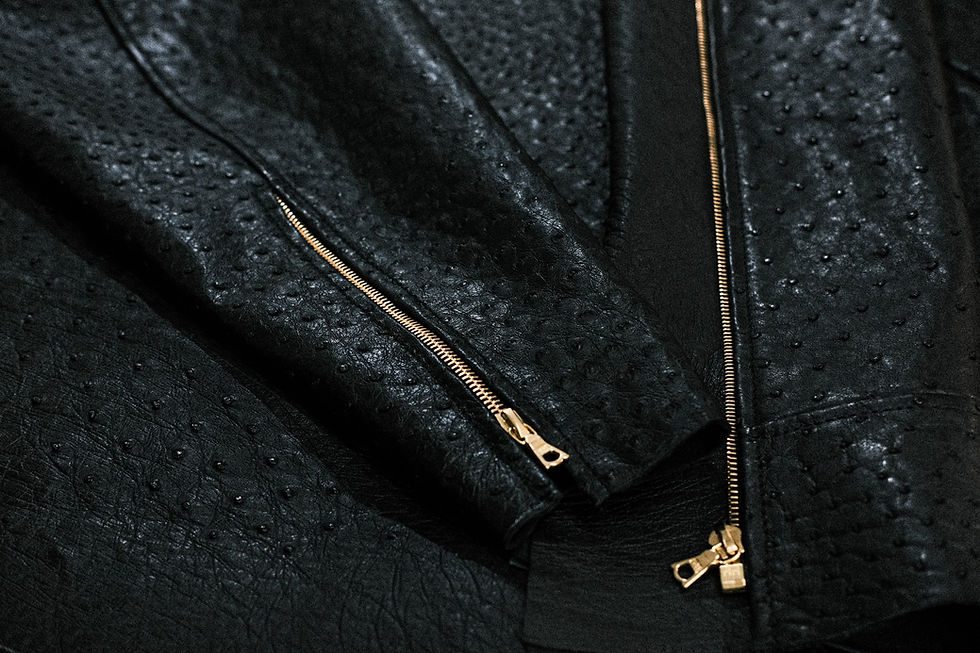
The Zipper Is Never Just a Zipper


Most people never think about a zipper until it fails. We think about it before the first stitch is placed.


A zipper on a bespoke piece is opened and closed thousands of times over the years it spends with its owner. It is a mechanical component built into something made by hand. It has to perform without hesitation for the life of the piece — and it has to feel right every single time.


We use two zippers. Each chosen for a specific reason.


Riri — Mendrisio, Switzerland · Since 1936


Riri zippers are produced in the canton of Ticino in southern Switzerland — the same region that has been making precision instruments and watches for over a century. Founded in 1936, Riri has spent nearly ninety years building zippers for the world's most demanding luxury houses. The metals are sourced and finished in Switzerland. The tolerances are Swiss.


What distinguishes a Riri zipper is not just durability — it is the quality of the glide. The weight in hand. The sound it makes. A Riri zipper does not catch. It does not drag. It opens and closes with a smoothness that feels engineered because it is. Each zipper is produced in brass, available in gold and gunmetal finishes, selected not for aesthetics alone but for how it performs under tension over years of use.


We use Riri on our backpacks, bags, and briefcases — pieces where the zipper faces daily use, where it is gripped, pulled, and tested thousands of times over years of serious carry. When you open a Walter Leather briefcase and the zip glides without a sound, that is a Riri. You will know it immediately.


YKK Excella — Japan · Since 1934


YKK was founded in Tokyo in 1934 and today produces more zippers than any other manufacturer on earth. That scale is not why we use them.


We use the YKK Excella — their premium line, produced in Japan with a level of finish that rivals any Swiss alternative. The Excella is a polished metal zipper, double-sided, with a chain constructed from brass elements that are individually formed and polished to a mirror finish. The result is a zipper that catches light, moves without resistance, and carries a quiet elegance that elevates every piece it is part of.


The Excella is our choice for jackets — where the zipper is the first thing a person touches, the detail that defines the first impression, and the component that must perform flawlessly every time a jacket is put on or taken off. On a Walter Leather bespoke jacket, that polished brass chain running from hem to collar is a YKK Excella. It catches light the way good hardware should — quietly, without announcing itself.


Two zippers. Two countries. Both chosen because they are the best at what they do — and because the piece they go into deserves nothing less.

The Leathers


Leather is not a single material. It is a family of materials — each tanned differently, sourced from different animals, finished for different purposes. Choosing the wrong leather for a commission is not a minor error. It changes the piece entirely.


These are the leathers we work with and what each one is built for.


Italian Lambskin — For Jackets and Garments


Italian lambskin is the material of choice for bespoke jackets and garments. Sourced from tanneries in Italy — the same region that has been producing the world's finest garment leathers for centuries — lambskin is defined by its lightness, its drape, and its extraordinary softness against the skin.


A lambskin jacket does not feel like armor. It feels like a second skin — one that moves with the body, breathes in ways heavier hides cannot, and develops a patina over years of wear that no other material can replicate. The grain is fine. The surface is consistent. It takes color beautifully, from deep blacks and rich burgundies to softer, more complex tones that shift in different light.


Lambskin is not for every piece. It rewards careful wear and responds to the environment it lives in. But for a bespoke jacket built around a specific person, there is no more personal material on earth.


Price category: Premium to Ultra-premium, depending on tannery origin and finish.


The Fabrics — Interior Linings For Bespoke Jackets


The outside of a Walter Leather jacket is leather. What lines the inside is a different conversation entirely — one that is just as considered, just as personal, and just as important to how the piece feels and performs over time.


The interior lining of a bespoke jacket is what touches the body. It determines warmth, breathability, texture against the skin, and the quiet luxury of putting the jacket on. We work with a curated selection of interior fabrics chosen for the same reasons we choose every other material: quality of origin, behavior over time, and how they serve the person wearing them.


Cashmere Lining — For Temperate and Formal Wear


Cashmere is the standard against which all other luxury fabrics are measured. Sourced from the undercoat of cashmere goats — primarily from Mongolia and Inner Mongolia — fine cashmere is defined by its micron count, its warmth-to-weight ratio, and the way it softens further with each wearing.


As an interior lining, cashmere transforms the act of putting on a jacket. The weight is present without being heavy. The warmth is immediate. The texture against the arm is something that has to be felt to be understood. We select cashmere weight and weave based on the client's climate and how the jacket will be worn — lighter for travel, heavier double-faced cashmere for colder conditions and more formal contexts.


Price category: Premium. Fabric sourcing from established Italian mills on request.


Perforated and Technical Fabric Lining — For Warmer Climates


For clients in warmer climates — or for jackets intended for travel between climates — we line with perforated fabrics and technical materials that allow the piece to breathe without compromising its feel or appearance.


A perforated lining retains the tactile quality of a premium interior while allowing air circulation that makes the jacket viable in heat. Technical fabrics in this category are selected for moisture management, weight, and how they behave against the body over hours of wear. The result is a jacket that performs in climates where most leather outerwear cannot.


Price category: Mid-premium to Premium.


Wool Lining — For Cold Climates


For commissions intended for serious cold — or for clients who want the warmth of a lined jacket without the weight of a full insulation layer — we work with fine wool linings from established mills, selected for density, texture, and how they hold their structure after years of use.

A wool-lined Walter Leather jacket is built for winter without apology. The leather exterior handles the elements. The wool interior handles the cold. Leather detailing on collars, cuffs, and panels ties the construction together into a single coherent piece.

Price category: Mid-premium to Premium.


Loro Piana and Designer Fabric Linings — For the Exceptional Commission


For clients who want no ceiling on the interior — we source from Loro Piana and equivalent designer fabric houses on commission.


Loro Piana fabrics represent the finest end of what woven textiles can be. Storm System wool that is windproof and water-resistant without a membrane. Baby cashmere from the first shearing of Hircus goats. Wish fiber — one of the rarest natural fibers on earth — woven into fabrics of extraordinary lightness and warmth. These are not materials you find in ready-to-wear. They are materials that require a commission to access.


A Walter Leather jacket lined in Loro Piana is an object that will outlast most things in the wardrobe by decades — and the interior will be part of why.


Price category: Ultra-premium. Quoted per commission based on fabric selection.

Every Element Is Tailored To You


There is no standard configuration. No default option. No combination that is more correct than another.


The lambskin or the pull-up leather, the Riri on the bag or the Excella on the jacket, the cashmere lining or the Loro Piana interior — each decision is made in conversation with the person the piece is being built for. What you carry. What you wear. Where you live. What your life actually looks like on a Tuesday morning or a Saturday at the track.


The material conversation is where the commission begins. Everything that follows — the sketch, the construction, the final piece — is the answer to what that conversation revealed.

When you are ready to begin, we are here.


Walter Leather Bespoke · Guadalajara Atelier · Est. 1990 The Quail · Pebble Beach · Amelia Island · Private Events Worldwide


Tags: Bespoke leather, Italian lambskin, pull-up leather, carbon fiber leather, Riri zipper, YKK Excella, Loro Piana, cashmere lining, bespoke jacket, bespoke backpack, leather artwork, Guadalajara atelier, wearable art


At Walter Leather, our passion for design is deeply rooted in the legacy of motorsport — the era when driving was an art, and every detail carried meaning. The Carrera Classic was born from this spirit. More than just a travel bag, it is a carefully crafted companion designed to honor the golden age of automotive style while serving the needs of modern-day enthusiasts.


The Inspiration Behind the Name

The name Carrera Classic draws from one of the most revered names in motorsport history — “Carrera,” meaning "race" in Spanish, and famously associated with the legendary Porsche Carrera models. These vehicles embodied performance, elegance, and endurance — values we wanted to translate into a travel piece. Just like the cars that inspired it, the Carrera Classic is built for movement, presence, and timeless appeal.


About the Pepita (Houndstooth) Pattern


The houndstooth pattern, also known as “Pepita,” dates back to the Scottish Lowlands in the 1800s, where it was originally woven in wool. It became iconic in the automotive world during the 1960s when Porsche introduced it as an interior fabric in models like the 911 and 356 — blending bold visual character with refined motorsport elegance.

Houndstooth (pepita pattern)

A Modern Essential, Built for the Journey

The Carrera Classic was designed with versatility in mind. Whether you're carrying a laptop and coffee mug to work, packing for a weekend drive up the coast, or attending a concours event, this bag is equally at home. It’s compact enough for daily use yet spacious enough for travel — a true weekender with purpose.

Each bag features a 100% cowhide leather exterior in refined hues like Café Oscura (dark brown) and Negra Oscura (deep black), paired with an interior built for functionality: two zippered pockets and an open leather pocket for organizing your essentials.


Carrera Classic a drivers classy leather travel bag

Limited Production – Unlimited Style

True to our philosophy, the Carrera Classic is produced in limited numbers. Each piece is handcrafted one by one, ensuring not just quality, but individuality. We believe in preserving exclusivity — just like the cars that inspired us, not everyone will have one, and that’s the point.

We’re committed to keeping the Carrera Classic as a lasting tribute — a timeless essential that blends heritage with function, design with story.


Walter Leather 

Bespoke Leather jackets
Custom Leather Bags 
Custom Leather backpacks

(916 )612-2554  Stephen H

(279) 201-4994 Ulises H

  • Pinterest
  • LinkedIn
  • Facebook
  • Instagram

Bespoke leather jackets since 1990 by Walter leather.

bottom of page